Building a permanent game layer inside a supermarket app
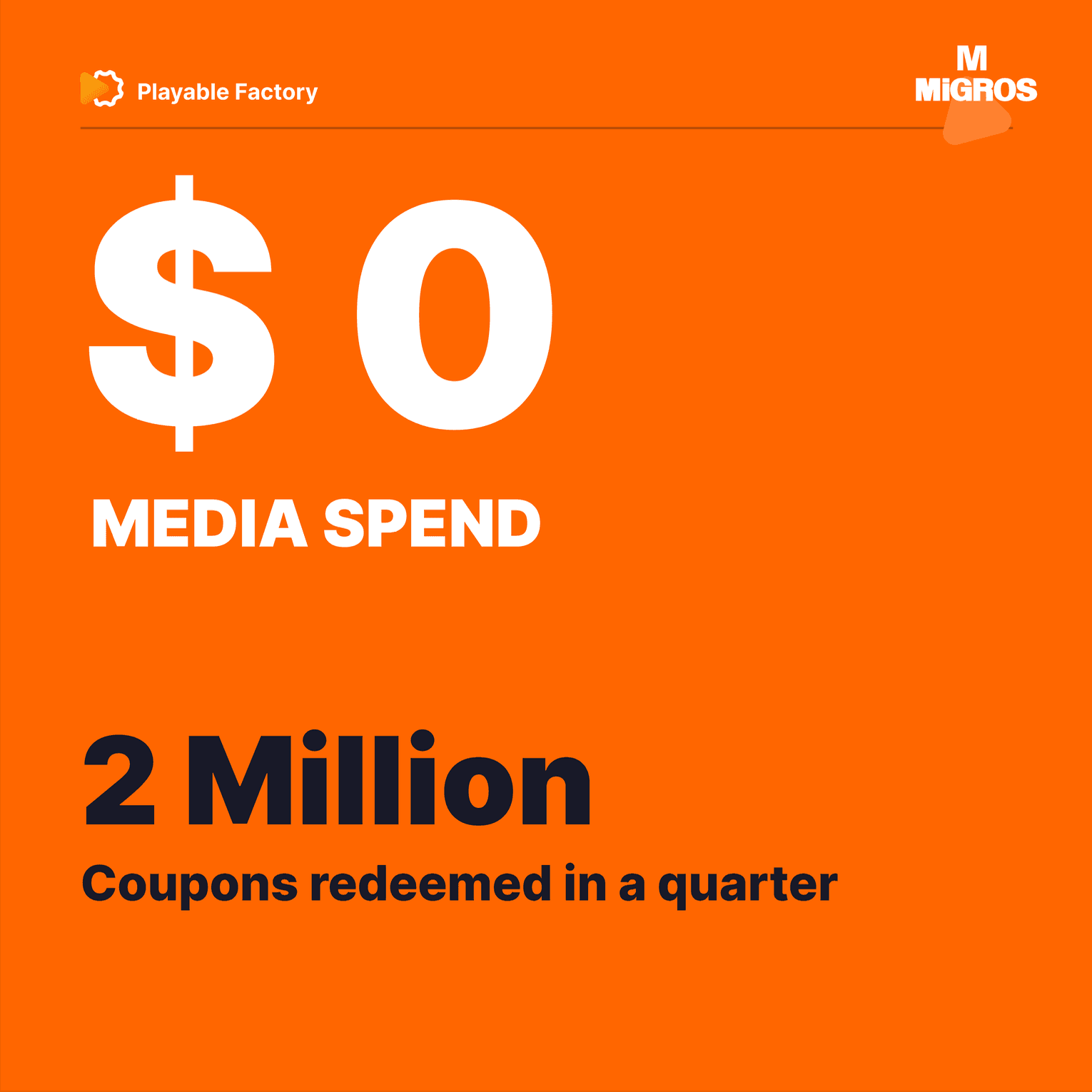
Migros didn't use Playable Factory's technology as an ad format. It used it as a permanent gamification layer running inside its own apps and over 19 months that layer produced 20.4 million game sessions and distributed 1.2 million coupon codes, with no media spend behind any of it.
1. The problem
A grocery app is opened out of necessity and closed as soon as an order is placed. Total contact between customer and brand adds up to the length of one weekly shop.
Migros wanted three things:
- A reason to open the app without placing an order
- A way to distribute coupons that feels like winning rather than receiving a discount
- A structure that adapts to the promotional calendar in days, not weeks
Native in-app games couldn't deliver that. Every release depended on an app store update, every new game was a separate development project, and performance across the Android device landscape was a real risk.
2. The solution
Playable Factory's playable engine was embedded in the Migros apps as a web layer. It's a use case outside what the format was built for, which is why the numbers don't look like advertising benchmarks.
The differences from a playable ad:
- User intent. An ad interrupts. Here the user arrives voluntarily, looking for a reward.
- Time pressure. An ad has seconds until skip. The game layer has no skip and no timer.
- CTA goal. An ad drives to an app store. The game layer wins a coupon or adds to basket.
- Distribution. An ad runs through networks. The game layer sits in-app and updates instantly.
The operating model matters as much as the technology. Each game is built once, then adapted to campaigns through "Ready" variations: different reward thresholds, different category art, different brand partner. That's how 38 games produced 312 variations. A new campaign doesn't open a new development project, and nothing waits for store approval.
3. The numbers
Nineteen-month totals (January 2, 2025 to July 30, 2026):
- Game sessions: 20.4M
- CTA clicks: 4.1M
- Coupon codes distributed: 1.2M
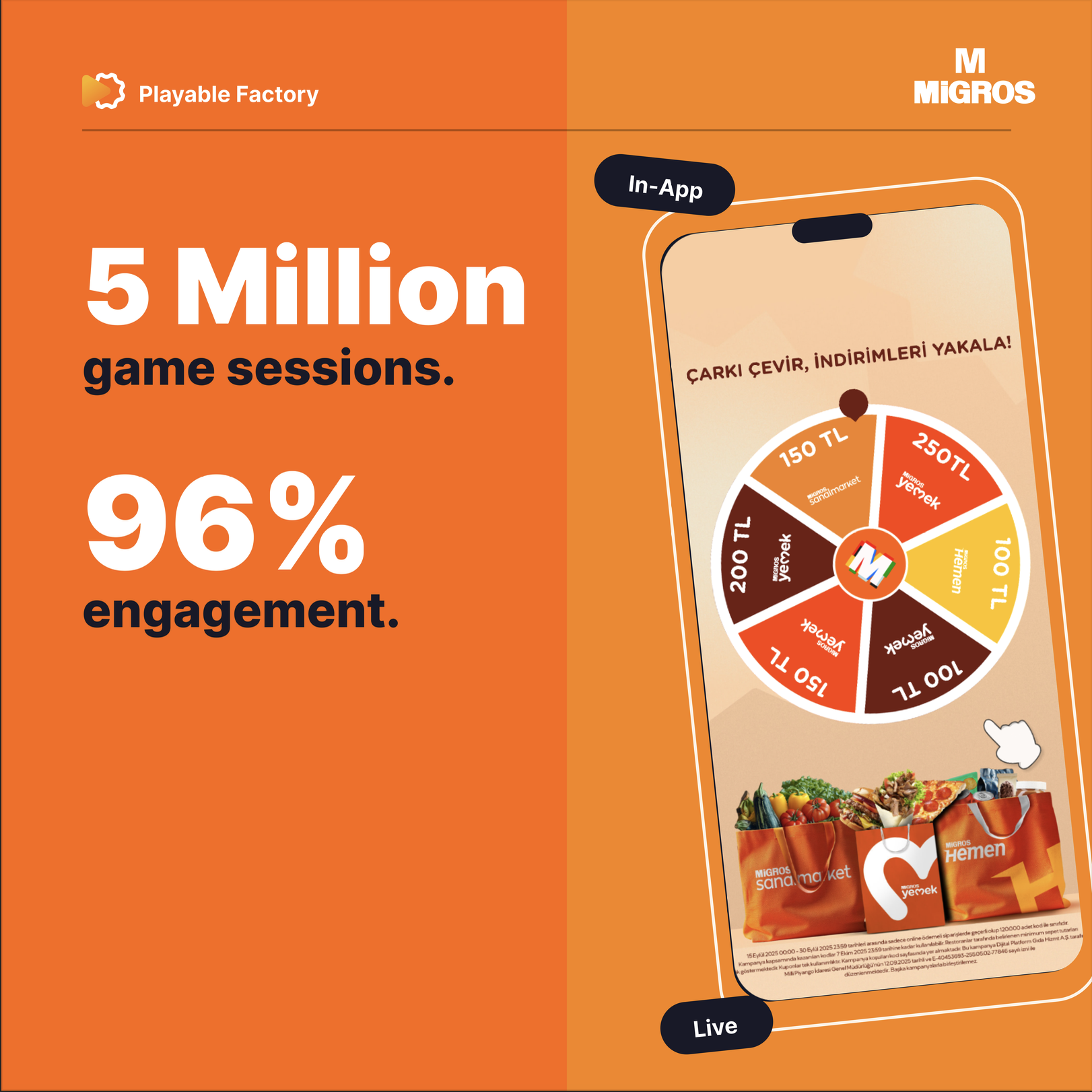
- Engagement rate: 96%
- Average win rate: 62.7%
- Games built: 38, producing 312 Ready variations
2026 against 2025:
- Sessions: 11.81M in 2025, 8.60M in the first seven months of 2026
- Daily sessions: 32.4K, then 41.0K, up 26%
- Engagement: 96.8%, then 95.8%
- Full-year 2026 projection: roughly 14.9M sessions
Seven months in, 2026 had already delivered 73% of all of 2025.
96% engagement across 20.4 million sessions is a portfolio average over 19 months, not a peak on one strong unit. Nobody is interrupted into these games. A user who opens the Migros app and taps into "Oyna Kazan" has already decided to play.
Coupon distribution is the point of the layer. Migros feeds a 7.5 million code pool into it, and 1.2 million codes have reached users.
Ten games ran in both years with identical mechanics, changed only through reward balancing, difficulty tuning and placement. All ten improved. Migros Yemek Runner went from 38.0% to 49.5% CTR, Oyna Kazan Match from 6.1% to 11.7%, Bounce from 4.2% to 9.5%. Average win rate rose from 52.0% to 62.7%.
The layer launched in Migros Hemen and moved to the other apps on the same builds. Sanal Market tripled, from 792K sessions to 2.34M. Migros Yemek is small in volume but converts hardest, at 49.2% CTR.
Supplier brands turned the layer into a revenue line. Games were co-designed with Coca-Cola, Algida, Ülker, Colgate, Superfresh and Petimo, and the brand segment averages 24.1% CTR, roughly double the evergreen games. Migros supplies the traffic, the brand supplies the budget, Playable Factory supplies the production.
More than 40 mechanics were tested. The ones where the reward is physically grabbed convert best:
- Claw: 545K sessions, 65.9% CTR
- Cup Shuffle: 490K sessions, 57.7% CTR
- Connect: 316K sessions, 38.3% CTR
- Catcher: 1.86M sessions, 36.3% CTR
The high-volume mechanics sit well below that: Basketball at 3.94M sessions and 10.1% CTR, Delivery at 2.78M and 19.0%, Match at 2.74M and 16.9%. Claw and Cup Shuffle have only run in short campaigns so far. Moving them into evergreen slots is the obvious next step.
4. Why it worked
The format matched the intent. Playable technology was designed to interrupt. Here the user is already looking for the game.
Production kept pace with campaigns. 38 games and 312 variations means a weekly category calendar doesn't trigger weekly builds.
Nothing depended on app releases. New game, new reward, new brand partner: none of it waits for store approval.
The loop optimizes itself. All ten comparable games improved year over year on reward balance and placement changes alone.
It scaled sideways cheaply. Sanal Market tripled on games built for Migros Hemen. The marginal cost of a new channel is a variation, not a project.
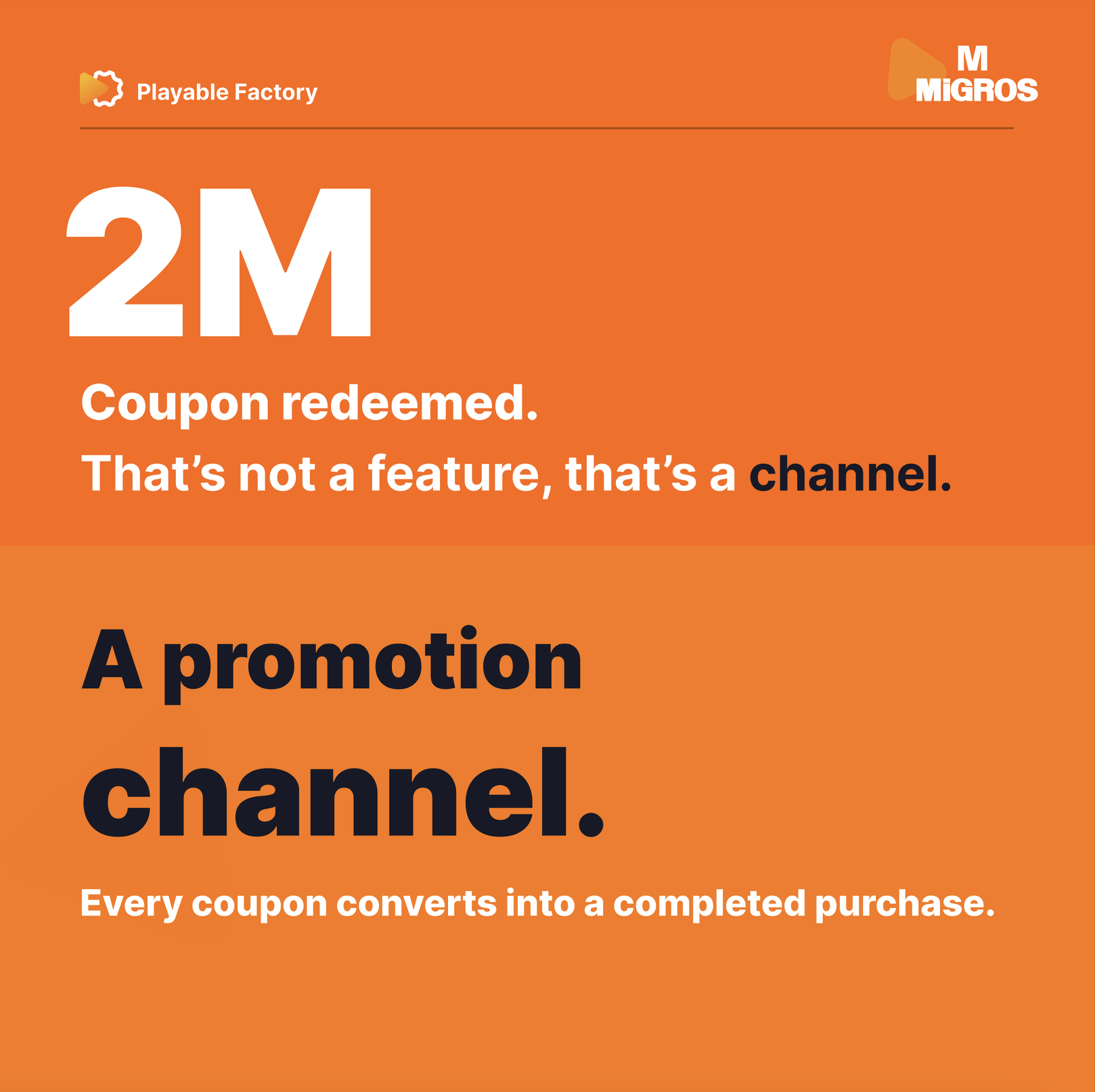
Migros now has a reason for customers to open the app when they aren't shopping, with no media spend, feeding straight into its own promotion economy.